I’ve lost count of how many dog parents come to us saying the same thing: “My lab chews everything. What crate height will keep him safe and secure?” As someone who’s spent years testing our crates with everything from escape-artist huskies to mouthy malinois, I get it. Choosing the right height isn’t just about comfort—it’s about safety, behavior, and peace of mind.
When your dog is a serious chewer, height plays a bigger role than most people realize. Get it wrong, and you could be dealing with bent doors, cracked teeth, or a full-blown escape. Let’s break down exactly what to look for—and how our team at Impact can help you choose the perfect fit.
Why Crate Height Matters for Chewers
When a crate is too short or poorly designed, chewing dogs don’t just get uncomfortable—they get creative. If your dog can reach the top corners or ventilation holes, those spots become prime chewing targets. And once they get a grip, it's only a matter of time before damage—and danger—follows.
Chewers often fixate on:
-
The crate door and latch area
-
Ventilation holes near the top corners
-
Any exposed edges or poorly welded seams
If the crate is too low, your dog might hunch or shift in awkward ways, triggering anxiety and excess chewing. If it’s too tall, you’re giving them room to rear up and grip the upper areas with their teeth—setting the stage for broken hardware or injuries.
We’ve seen dogs bend standard wire crates wide open with their mouths. That’s why a properly sized height, paired with strong materials, is key to keeping your dog safe and the crate intact.
How to Measure Your Dog for the Perfect Height
Getting the right crate height starts with accurate measuring—this is your foundation for success. Here’s the process we follow every time we recommend a size for a high-chewing dog.
-
Stand your dog on a flat surface.
-
Measure from the floor to the top of the shoulders (withers).
-
Add 2–3 inches to ensure enough clearance for sitting and standing comfortably.
This gives you the minimum interior height your crate should provide. Then, confirm:
-
The door opening height allows your dog to enter and exit without ducking.
-
The crate’s interior ceiling clears your dog’s head while standing tall.
Here are a few common sizing mistakes to avoid:
-
Choosing a crate that’s too tall, which encourages vertical movement and gives chewers more reach.
-
Going too small, forcing your dog to hunch, and increasing stress chewing.
-
Failing to measure your dog while standing upright (not curled up or lying down).
-
Forgetting to check both interior height and door clearance—both matter.
If you’re stuck between sizes or measuring a young pup expected to grow, our team is always happy to guide you.
Why Aluminum Crates Excel for Chewing Breeds
We designed our crates with power chewers in mind—because we’ve raised them ourselves. Whether it’s a determined pit bull or a husky with anxiety, the right material makes all the difference.
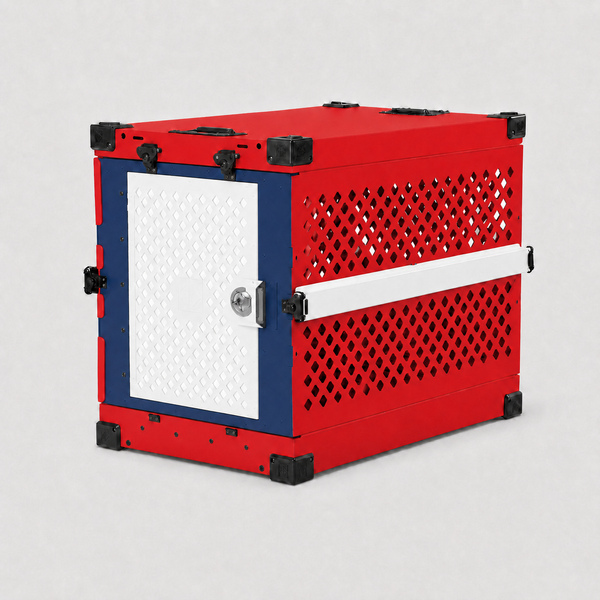
Our aluminum crates offer several built-in features that discourage chewing and prevent damage:
-
Reinforced corners and welded seams: No weak points or exposed welds for dogs to target.
-
Small, rounded ventilation holes: No sharp edges or chewable gaps.
-
Durable powder-coated finish: Smooth surface resists scratches and bite marks.
And if you’ve got a serious escape artist? Our High Anxiety Crate is engineered with a secondary latch system, thicker gauge aluminum, and a solid frame to withstand the most determined chewers.
Every crate comes with our lifetime warranty and dog-damage guarantee. If your dog manages to damage any part of your crate, we’ll make it right—no stress, no fuss.
Choosing the Right Model & Size
Once you’ve nailed down height, the next step is choosing between our Collapsible and Stationary crate models. Both are aluminum, chew-resistant, and built to last—but one might suit your dog’s habits and your lifestyle better.
Here’s a quick comparison for chewing breeds:
Collapsible Crates
-
Easy to fold down for travel or storage
-
Locking mechanism is secure but may require supervision for aggressive chewers
-
Best for dogs who chew less when settled or while traveling
Stationary Crates
-
One-piece frame with no folding joints—maximum strength
-
No movement or give, even with heavy biting
-
Ideal for daily use with high-anxiety or high-chewing dogs
If your dog is still in training or tends to chew when left alone, the Stationary model often offers the most peace of mind. But we’ve seen great results with the Collapsible model too—especially for dogs who are crate-trained and just need something sturdy.
Next Steps
Choosing the right crate height is more than just a number—it’s about creating a secure, stress-free environment for your chewing-prone pup. Start by measuring from the floor to the shoulders, then add those 2–3 extra inches for safety and comfort. Pair that with a durable, chew-proof material like aluminum, and you’ve got a setup built to last.
Need help picking the perfect size or model? Take our Crate Quiz for personalized recommendations, or browse our full collection to see what makes our crates the gold standard for chewing breeds. We’ve got your back—and your dog’s, too.